%201.svg)
About Growing Up data - Old
About Growing Up in New Zealand data
Growing Up in New Zealand (GUiNZ) is a rich longitudinal data resource on child and youth development that provides a detailed picture of what it is like to grow up in Aotearoa today, and how children’s experiences, environments, relationships and circumstances shape their wellbeing over time.
Growing Up in New Zealand data are used by researchers, government agencies and policy analysts to better understand the lives of young people and their whānau, and to inform policy, services and public discussion.
Strengths of the data
Growing Up in New Zealand is a nationally significant data resource. Depending on which data set is used, the strengths can include:
- Longitudinal insight
The study follows the same cohort over time, allowing researchers to examine change, development, transitions and longer-term outcomes from before birth through to adolescence. - Breadth and depth
The data covers a wide range of areas, including health, education, family and whānau life, culture, identity, housing, neighborhoods, social connections, mental wellbeing and life beyond school. - Multiple perspectives
Information has been collected from children and young people, mothers, partners, caregivers, teachers and other sources at different stages of the study. - A contemporary Aotearoa New Zealand focus
The study reflects the experiences of young people and families growing up in New Zealand today, across diverse cultural, social and economic contexts. - Policy and research value
The data supports research, policy development, service design and decision-making across many areas of child, youth and whānau wellbeing.
Growing Up Datasets
Growing Up in New Zealand data is held securely by two organisations:
- University of Auckland– comprises the full cohort and all data collected by the study.
- Stats NZ– comprises a sub-cohort who have consented for most of their data to be shared with StatsNZ for linkage in the IDI.
You can learn more about the difference between these two data sets below.
Which data is best for me?
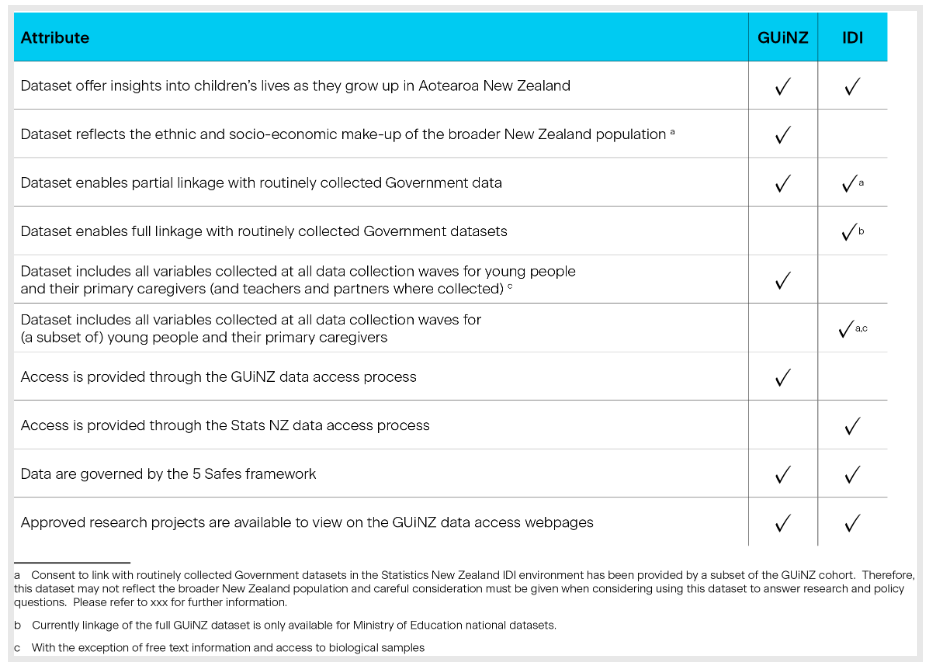
Deciding which dataset is best for you will depend on your research question. If you would like to link the GUiNZ cohort dataset to other routinely collected Government datasets using the National Health Index (NHI) then you will need to apply to use the data held by Stats NZ. If you do not need to link to any routinely collected Government datasets then you should apply to use the data held by the University of Auckland.
The following table provides some of the key attributes of the datasets held by the University of Auckland and Stats NZ.
04
Research methodology
Descriptive statistics were used to report mental wellbeing, anxiety symptoms, depression symptoms, and peer relationships across sociodemographic groups, presented by ethnicity, gender identity, disability status, area-level deprivation, rurality, and material hardship trajectories.
Caregiver experiences of material hardship trajectories between 9-months and 15-years of age were categorised into four clusters: No material hardship, some exposure to hardship, persistent material hardship, and increasing material hardship.
To identify factors linked to mental health at age 15, multivariable analyses were conducted in three stages: 1) accounting for sociodemographic factors; 2) adding structural factors such as material hardship and discrimination; 3) incorporating educational (school satisfaction, academic buoyancy) and social factors (cultural connectedness, peer relationships). Multivariable analyses help separate the effects of these factors to answer the question: “If two young people were similar in every way except for one experience, how much would that experience change their mental health outcomes?” This approach provides insights into drivers of adolescent mental health and wellbeing, and where targeted interventions may have the greatest impact.
For full details, see the NWA15 Methods Paper, NWA15 Mental Health and Wellbeing Snapshot Supplementary Materials’ and the ‘NWA15 Material Hardship Technical Report’.

05
Insight one
Mental wellbeing for young people with a disability.
Young people with a disability reported poorer levels of mental wellbeing, higher anxiety symptoms and higher depression symptoms compared to peers without a disability.
This graph is best viewed in landscape.
06
Insight two
Mental wellbeing and gender identities.
Overall, cisgender girls, transgender, and non-binary young people were more likely to report lower mental wellbeing, higher anxiety symptoms, and higher levels of depression than cisgender boys. Nonetheless, they also reported having more positive peer relationships than cisgender boys.
This graph is best viewed in landscape.
09
Insight five
School satisfaction, academic buoyancy, and mental health and wellbeing.
On average, young people who were more satisfied with school or reported greater academic buoyancy reported greater mental wellbeing, lower anxiety symptoms, lower depression symptoms, and more positive peer relationships, even when accounting for other factors.

10
Implications for policy & practice
Youth mental health and wellbeing in Aotearoa New Zealand are shaped by complex social and individual factors. Government documents such as the Government Policy Statement on Health, The Child and Youth Strategy, and Kia Manawanui Aotearoa: Long term pathway to mental wellbeing, outline various national-level objectives and commitments relevant to the wellbeing of children and young people.
Findings from the Growing Up in New Zealand study show disparities among ethnic and gender groups and those facing discrimination and disability. Findings also highlight the protective role of peer relationships and the importance of positive, supportive school environments.
Addressing these disparities while reinforcing protective factors requires coordinated youth-focused policies and capacity-building for responsive services that ensure equitable and positive outcomes for all young people.
Persistent inequities in mental health outcomes remain a priority for action.
Findings from the Growing Up in New Zealand study reveal significant disparities among young people.
- Young people identifying as transgender, non-binary, or cisgender girls, as well as young people identified as having a disability or having experienced any form of discrimination, report lower mental wellbeing and higher symptoms of anxiety and depression.
- These disparities highlight the urgent need for tailored interventions and culturally responsive services that identify and address structural barriers and promote equity across diverse youth populations.
Supportive factors must be reinforced.
Positive educational experiences, such as school satisfaction, academic buoyancy, and strong peer relationships, are linked to better mental wellbeing and fewer symptoms of anxiety and depression.
- These findings speak to the impact of educational settings and experiences on young people’s mental health and wellbeing.
- The relationship between these educational constructs and mental health and wellbeing of young people in the Growing Up in New Zealand cohort is relevant at both for the education sector at both a governance and operational level.
Social determinants and human rights-based approaches matter.
Mental health outcomes are shaped by social, cultural, and economic factors.
- Experiences of any form of discrimination strongly correlated with poorer mental health and represent violations of the right to freedom from discrimination, as guaranteed by the New Zealand Bill of Rights Act (Section 19) and the United Nations Convention on the Rights of the Child (Article 2).
- Ensuring young people are able to realise their rights to freedom from discrimination will require coordinated efforts at various relevant tiers of decision-making.
Our fact sheets provide information about the constructs and measures which have been used during data collection to understand the lives of children growing up in Aotearoa New Zealand. They also describe how the data can be used to contribute to policy and they offer ideas for research using Growing Up in New Zealand data.

Identity and Belonging | Fact sheet | May 2026

Learning and Development | Fact sheet | May 2026

Food security and nutrition | Fact sheet | May 2026

Family Wellbeing | Fact sheet | May 2026

Housing and communities | Fact sheet | May 2026

Mental wellbeing | Fact sheet | May 2026

Material wellbeing | Fact sheet | May 2026

Child health | Fact sheet | May 2026

Stepping into adolescence: Emerging autonomy and independence - Now We Are Twelve | Extended fact sheet | August 2023
