%201.svg)
Now We Are 15 | Snapshot 03
Young people’s experiences of self-harm and thoughts of suicide at age 15
01
Introduction
Suicide and self-harm among young people affect every community in Aotearoa New Zealand. While most young people in the Growing Up in New Zealand cohort reported positive wellbeing at age 15, a small proportion reported experiences of self-harm or serious thoughts of suicide in the previous 12 months. It is important to note that this snapshot does not present how common self-harm or thoughts of suicide are in the wider population. Rather, it reports on the young people in the Growing up in New Zealand cohort who reported self-harm or serious thoughts of suicide, helping us to understand who is affected.
This snapshot draws data from the 15-Year Check Point to examine the experiences of young people who reported self-harm or serious thoughts of suicide at age 15. Rather than focusing on individual behaviour alone, the snapshot situates these experiences within broader social, economic, and structural contexts. The findings highlight how experiences vary by gender identity, material hardship, area-level deprivation, and ethnicity.
By examining these factors together, the snapshot supports an understanding of young people’s distress and wellbeing within their full social and environmental context. The findings reinforce the importance of early intervention, accessible and appropriately tailored support, and coordinated responses across sectors. This evidence is intended to inform decision-makers and practitioners working to support young people, whānau, and communities, and to contribute to collective efforts toward Pae Ora.

02
Key findings
Key findings from this research are:
1.
Experiences of self-harm and serious thoughts of suicide at age 15 were concentrated within a small subset of the Growing Up in New Zealand cohort. 72% of young people did not report any experiences of self-harm, and 80% did not report any experiences of serious thoughts of suicide.
2.
Of those who reported self-harm or serious thoughts of suicide, cisgender girls made up the largest percentage across most ethnic groups, followed by transgender and non-binary young people.
3.
Socioeconomic conditions may contribute to ethnic differences in self-harm and thoughts of suicide at 15 years of age, with rangatahi Māori who reported self-harm or serious thoughts of suicide, around 27% were living in the most deprived neighbourhoods, compared with 8% of European/MELAA/Other young people.
4.
Material hardship may contribute to ethnic differences in self-harm at 15 years of age, with 39% of rangatahi Māori who reported self-harm experiencing some form of material hardship over time, compared with 18% of European/MELAA/Other.
03
About the report
This snapshot examines experiences of self-harm and serious thoughts of suicide among 15-year-olds in Aotearoa New Zealand who are part of the Growing Up in New Zealand study. The findings provide insight into how these experiences are shaped by social and structural factors, and how they differ within and between ethnic groupings.
Key definitions that are integral to the interpretation of findings of the snapshot:
Self-harm
Deliberately hurting oneself or doing something known to cause harm, regardless of whether there is suicidal intent.
Serious thoughts of suicide
Seriously thinking about killing oneself or attempting suicide in the previous 12 months.
Material hardship
Difficulty meeting basic household needs, measured longitudinally between 9 months and 15 years of age and grouped into distinct hardship trajectories.
Area-level deprivation
A measure of neighbourhood socioeconomic conditions based on the New Zealand Deprivation Index (NZDep).
Disability
Young people who identified as having a disability or long-term condition that affects everyday activities.
04
Research methodology
This snapshot uses data from the Now We Are 15 data collection wave of the Growing Up in New Zealand study. Young people were asked whether, in the previous 12 months, they had deliberately harmed themselves or had serious thoughts about killing themselves. Responses were analysed for those who answered “yes” to either question.
Findings are reported by self-identified ethnicity using prioritised ethnicity groupings. Due to small numbers, some ethnic groups were combined for reporting purposes only. Analyses also considered gender identity, disability status, area-level deprivation, rurality, and longitudinal experiences of material hardship.
Material hardship trajectories were derived from caregiver reports collected between infancy and age 15 and categorised as no material hardship, some exposure, persistent hardship, or increasing hardship over time.
This snapshot focuses on understanding the characteristics and contexts of young people who reported self-harm or serious thoughts of suicide, rather than estimating prevalence in the wider population. Young people’s free-text responses are included to provide context and depth to the quantitative findings.
Further methodological detail is available in the Now We Are Fifteen Methods paper, Suicide and Self-Harm Snapshot Supplementary Materials and the Material Hardship Technical Document.

05
Insight one
Reports of self-harm and serious thoughts of suicide.
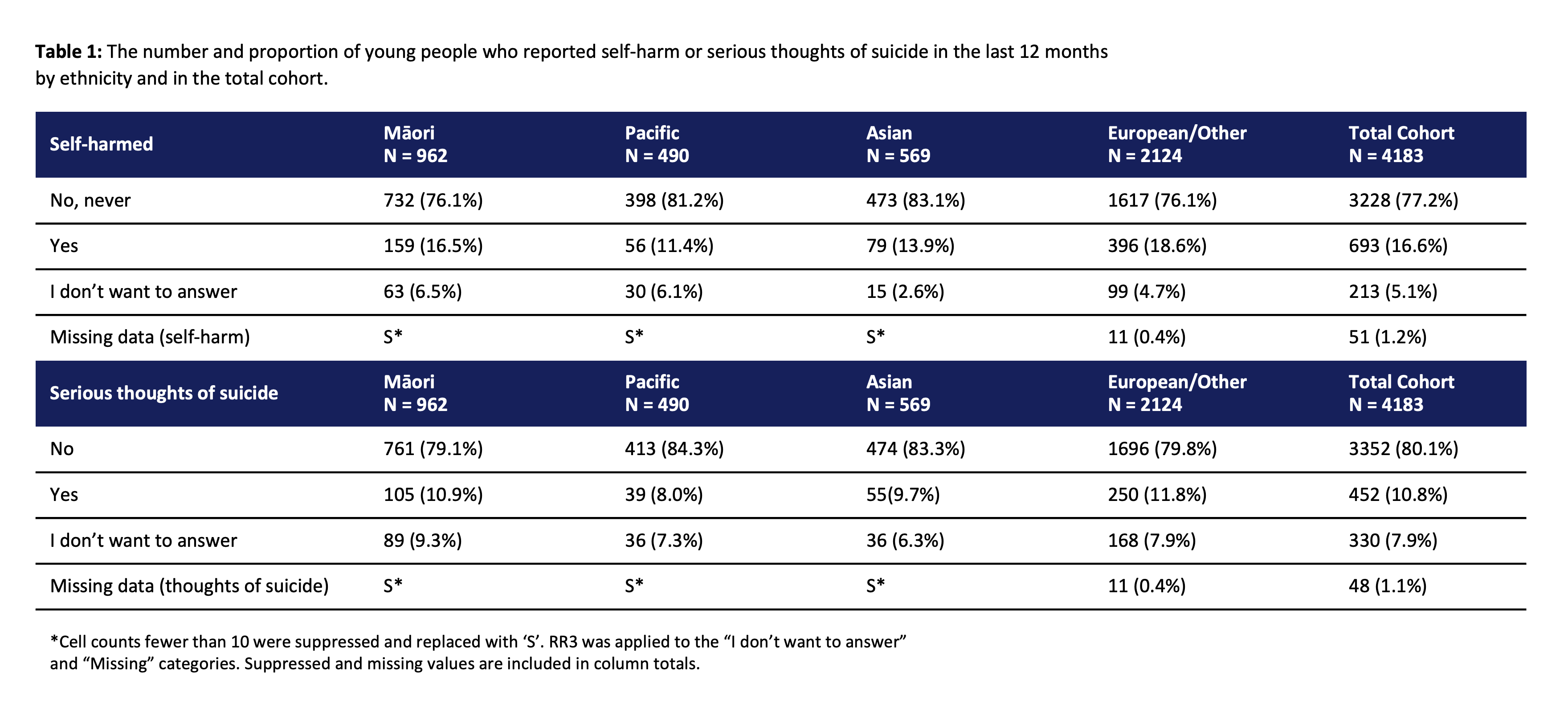
Overall, 77.2% of young people in the Growing Up in New Zealand cohort said they had not self-harmed in the last 12 months . However, 1 in 6 young people reported engaging in self-harm behaviours, with 6.2% of young people who had reported self-harm, reported having self-harmed three or more times in the previous 12 months.
Most young people (80.1%) reported no serious thoughts of suicide in the last 12 months. However, approximately 10.8% of young people in the Growing Up in New Zealand cohort reported that they had.
06
Insight two
Gender identities
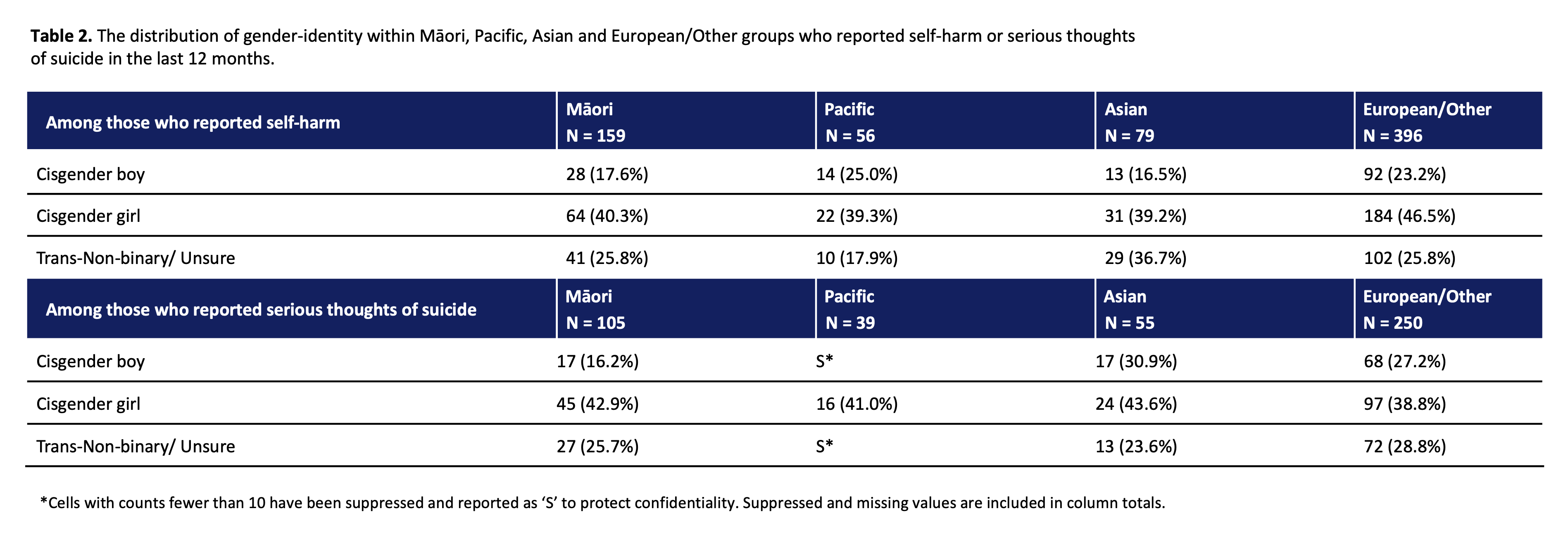
The percentage of serious thoughts of suicide was greatest amongst cisgender girls within the Māori and European/MELAA/Other ethnic groupings, followed by trans/non-binary/unsure and then cisgender boys.
Amongst rangatahi Māori who reported self-harm in the previous 12-months, 40.3% identified as cisgender girl, 25.8% identified as trans/non-binary/unsure and 17.6% identified as cisgender boy. Within the Asian and European/MELAA/Other groupings, the largest percentage of those reporting self-harm identified as cisgender girl, followed by trans/non-binary/unsure and then cisgender boy.
Interestingly, a slightly different pattern was observed among Pacific young people, with the largest percentage of those who reported self-harm behaviours in the previous 12-months identifying as cisgender girls (39.3%), followed by cisgender boys (25.0%) and then those who identified as trans/non-binary/unsure (17.9%).
07
Insight three
Area-level deprivation and rangatahi Māori.
The largest percentage of rangatahi Māori who reported self-harm in the previous 12-months lived in the most deprived areas of NZ (27.0%, Quintile 5). In contrast, amongst European/MELAA/Other young people who reported self-harm, the majority lived in the least deprived areas of NZ (30.1%, Quintile 1). We also found large differences between rangatahi Māori and European/Other young people who reported self-harm even at a similar level of socioeconomic deprivation, with 27% of rangatahi Māori who reported self-harm living in Quintile 5 compared with approximately 9% of European/MELAA/Others who reported self-harm living in Quintile 5.
A similar pattern was observed amongst those who reported serious thoughts of suicide in the last 12-months: amongst rangatahi Māori the largest percentage of reports were for those living in the most deprived areas of NZ (26.7%, Quintile 5) whereas for European/Other the largest proportion of reports were for those living in less deprived areas (29.6%, Quintile 2). Furthermore, the percentage of rangatahi Māori who reported serious thoughts of suicide living in the most deprived areas was 26.7%, whereas European/MELAA/other was 7.6%.

08
Insight four
Material hardship over time.
Approximately 72.2% of European/MELAA/Other young people, and almost 45.9% of rangatahi Māori, who reported self-harm had not experienced material hardship in their lives (between the ages of 9 months and 15 years). Among rangatahi Māori who reported self‑harm, approximately 14.5% experienced “some” material hardship, 16.4% experienced “increasing” hardship, and 8% had experienced “persistent” material hardship. In contrast, among European/MELAA/Other young people who reported self‑harm, 3.8% experienced increasing hardship, 9.6% some hardship, and 4.3% persistent material hardship.
Among rangatahi Māori who reported serious thoughts of suicide, 18.1% experienced increasing hardship whereas for European/MELAA/Other young people who reported serious thoughts of suicide, approximately 4% experienced increasing hardship.

09
Insight five
Context and cumulative experience.
Young people’s free-text responses illustrate that experiences of self-harm and serious thoughts of suicide reflect complex and cumulative pressures over time, rather than any single event. These insights highlight the importance of understanding young people within their whānau, school, and community contexts.

09
Implications for policy & practice
This snapshot shows that experiences of self-harm and serious thoughts of suicide among 15-year-olds are shaped by multiple, interconnected social and structural factors. Differences by gender identity, material hardship, and deprivation highlight the importance of responses that extend beyond the health system alone. The findings support the need for coordinated action across government, education, health, and community.
A whole-of-system response.
The findings reinforce that suicide prevention is not solely a clinical issue. National strategies call for a “whole-of-government, whole-of-society” approach. Prevention requires systems that work together to support young people early, rather than only responding once distress escalates.
Support must be inclusive and accessible.
Across most ethnic groups, higher reporting of self-harm was observed among cisgender girls, transgender and non-binary young people. The report indicates these patterns reflect broader social and structural conditions. Services should therefore be inclusive, culturally appropriate, and responsive to diverse needs, alongside strong support for whānau and communities.
Reduce material hardship over time.
Strengthen and target policies that reduce child and youth material hardship over time, including early intervention and sustained supports for whānau experiencing persistent or increasing hardship, and ensure supports are designed to be accessible and appropriately tailored.
Good data supports better decisions.
The report also emphasises the importance of high-quality data that can show differences within and between groups. When data are disaggregated, patterns of inequity become visible and can be addressed. This helps ensure that policies and programmes are designed appropriately and that resources are directed to where they are most needed. Continuing to listen to young people and capture their experiences supports better decision-making and accountability.
10