%201.svg)
Now We Are 15 | Snapshot 02
Mental Health and Wellbeing
01
Introduction
Adolescent mental health is a public health and policy priority in New Zealand. This snapshot draws on data from the Growing Up in New Zealand study to provide insights into four important aspects of mental health and wellbeing for 15-year-olds: mental wellbeing, anxiety symptoms, depression symptoms, and peer relationships. Findings are presented in the context of priority populations and longitudinal experiences of material hardship.
Adolescence is a critical developmental stage marked by rapid physical, social, and emotional changes. During these transitions, anxiety and lowered mood can occur. Factors such as material hardship, discrimination, access to supportive services, and the quality of school and surrounding environments influence adolescent mental health and wellbeing outcomes.
The evidence shows differences in outcomes by gender, ethnicity, disability status, exposure to neighbourhood deprivation, and experiences of any form of discrimination. This report examines these associations, providing evidence to inform policy and action for developing tailored support and services that enhance adolescent mental health and wellbeing in Aotearoa New Zealand.
02
Key findings
Key findings from this research are:
1.
Mental health and wellbeing patterns varied across gender identities: cisgender girls, transgender, and non-binary youth reported higher anxiety and depression symptoms, and poorer mental wellbeing than cisgender boys, yet also reported more positive peer relationships.
2.
Overall, young people who were identified as having a disability reported poorer mental wellbeing, less positive peer relationships, and higher symptoms of anxiety and depression compared to those without a disability.
3.
Experiencing any form of discrimination was associated with lower levels of mental wellbeing, higher anxiety symptoms, higher depression symptoms, and having less positive peer relationships.
4.
Higher school satisfaction and higher academic buoyancy was associated with greater mental wellbeing, fewer symptoms of anxiety and depression, and more positive peer relationships.
5.
Most young people reported relatively positive peer relationships: 84% of young people reported having good friends, and 79% reported trusting their friends. When other factors are considered, having positive peer relationships was linked to better mental wellbeing and lower anxiety and depression symptoms.
03
About the report
This snapshot draws on Growing Up in New Zealand data to examine four aspects of mental health and wellbeing for 15-year-olds in New Zealand: mental wellbeing, anxiety symptoms, depression symptoms, and peer relationships.
Key definitions that are integral to the interpretation of findings of the snapshot:
Mental wellbeing
A state of mental, physical, and social wellbeing, encompassing positive psychological, emotional, social, and learning functioning and managing the everyday stresses of life.
Mental health
The continuum that encompasses both positive and negative experiences of mental being and emotion.
Anxiety symptoms
Excessive and persistent anxiety or worry, which may cause physical responses like tension, increased heart rate, nervousness, and reduced concentration.
Depression symptoms
Prolonged feelings of depressed mood (sadness, irritability, emptiness) that may be accompanied by loss of interest, low self-worth, or hopelessness, often paired with changes in sleep, appetite, and energy.
Discrimination
In the context of this snapshot, refers to being treated unfairly or differently compared to other people. Common grounds for discrimination include age, skin colour, manner of dress or appearance, race or ethnic group, accent or language spoken, gender, sexual orientation, religious beliefs, disability or health issues, among other reasons.
Academic buoyancy
Ability of an individual to deal with everyday setbacks that are common parts of everyday school life, such as the stress related to marks, deadlines, or schoolwork challenges.
Transgender
Someone whose gender identity is different from the sex they were assigned at birth.
Non-binary
Someone whose gender identity does not fit exclusively into the categories of “man” or “woman.” They may identify as both, neither, somewhere in between, or in a different way entirely.
Cisgender
Someone whose gender identity matches the sex and gender they were designated at birth.

04
Research methodology
Descriptive statistics were used to report mental wellbeing, anxiety symptoms, depression symptoms, and peer relationships across sociodemographic groups, presented by ethnicity, gender identity, disability status, area-level deprivation, rurality, and material hardship trajectories.
Caregiver experiences of material hardship trajectories between 9-months and 15-years of age were categorised into four clusters: No material hardship, some exposure to hardship, persistent material hardship, and increasing material hardship.
To identify factors linked to mental health at age 15, multivariable analyses were conducted in three stages: 1) accounting for sociodemographic factors; 2) adding structural factors such as material hardship and discrimination; 3) incorporating educational (school satisfaction, academic buoyancy) and social factors (cultural connectedness, peer relationships). Multivariable analyses help separate the effects of these factors to answer the question: “If two young people were similar in every way except for one experience, how much would that experience change their mental health outcomes?” This approach provides insights into drivers of adolescent mental health and wellbeing, and where targeted interventions may have the greatest impact.
For full details, see the NWA15 Methods Paper, NWA15 Mental Health and Wellbeing Snapshot Supplementary Materials’ and the ‘NWA15 Material Hardship Technical Report’.

05
Insight one
Mental wellbeing for young people with a disability.
Young people with a disability reported poorer levels of mental wellbeing, higher anxiety symptoms and higher depression symptoms compared to peers without a disability.
This graph is best viewed in landscape.
06
Insight two
Mental wellbeing and gender identities.
Overall, cisgender girls, transgender, and non-binary young people were more likely to report lower mental wellbeing, higher anxiety symptoms, and higher levels of depression than cisgender boys. Nonetheless, they also reported having more positive peer relationships than cisgender boys.
This graph is best viewed in landscape.
07
Insight three
Experiences of discrimination and mental health and wellbeing.
On average, young people who have experienced any form of discrimination reported lower mental wellbeing, higher anxiety symptoms, higher depression symptoms, and less positive peer relationships, even when accounting for other factors.

08
Insight four
Peer relationships and mental wellbeing.
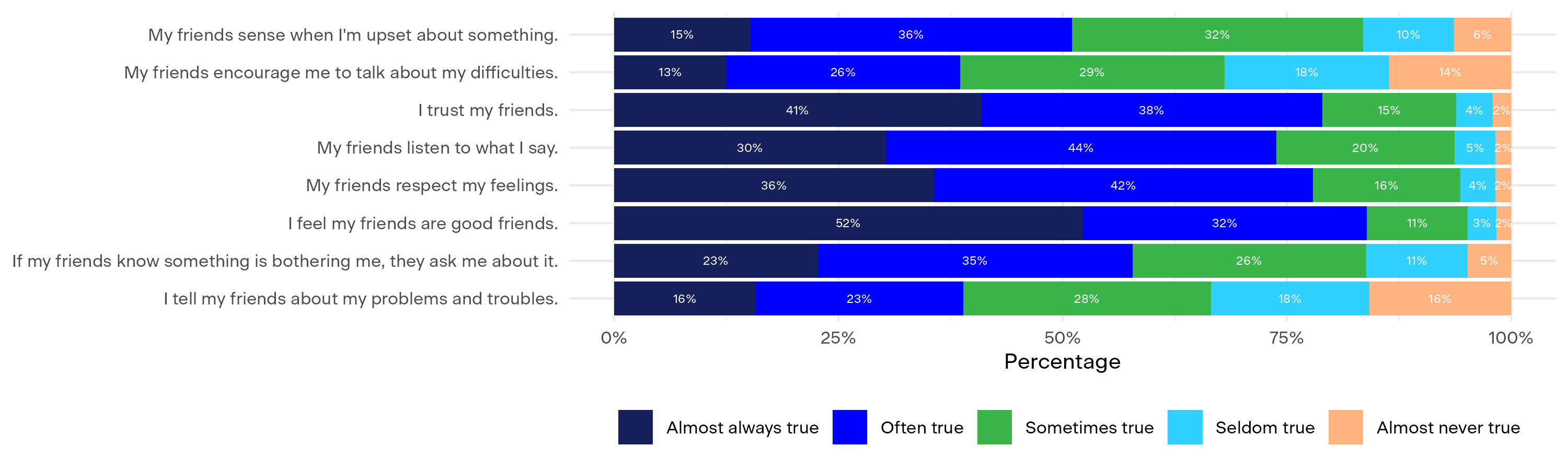
Most young people reported having positive peer relationships, characterised by strong peer trust and respect — 84% feel that they have good friends. 39% reported of young people said that their friends often and almost always encourage them to talk about their difficulties.
Having supportive friendships was linked to better mental wellbeing and lower anxiety and depression symptoms. More positive peer relationships were fostered by greater cultural connection, not experiencing discrimination, greater satisfaction with school, and higher levels of academic buoyancy.
What young people said:
“I’m very able to look after myself because I [have] very useful life skills ... I also know how to look after myself mentally, like I know what to do if I’m feeling stressed, and I also know how to look after myself physically like getting enough exercise...”
“... I think the best thing about being me is that I have such an amazing group of friends that are supportive, kind, and very funny. You will never not catch me laughing with them.”
09
Insight five
School satisfaction, academic buoyancy, and mental health and wellbeing.
On average, young people who were more satisfied with school or reported greater academic buoyancy reported greater mental wellbeing, lower anxiety symptoms, lower depression symptoms, and more positive peer relationships, even when accounting for other factors.

10
Implications for policy & practice
Youth mental health and wellbeing in Aotearoa New Zealand are shaped by complex social and individual factors. Government documents such as the Government Policy Statement on Health, The Child and Youth Strategy, and Kia Manawanui Aotearoa: Long term pathway to mental wellbeing, outline various national-level objectives and commitments relevant to the wellbeing of children and young people.
Findings from the Growing Up in New Zealand study show disparities among ethnic and gender groups and those facing discrimination and disability. Findings also highlight the protective role of peer relationships and the importance of positive, supportive school environments.
Addressing these disparities while reinforcing protective factors requires coordinated youth-focused policies and capacity-building for responsive services that ensure equitable and positive outcomes for all young people.
Persistent inequities in mental health outcomes remain a priority for action.
Findings from the Growing Up in New Zealand study reveal significant disparities among young people.
- Young people identifying as transgender, non-binary, or cisgender girls, as well as young people identified as having a disability or having experienced any form of discrimination, report lower mental wellbeing and higher symptoms of anxiety and depression.
- These disparities highlight the urgent need for tailored interventions and culturally responsive services that identify and address structural barriers and promote equity across diverse youth populations.
Supportive factors must be reinforced.
Positive educational experiences, such as school satisfaction, academic buoyancy, and strong peer relationships, are linked to better mental wellbeing and fewer symptoms of anxiety and depression.
- These findings speak to the impact of educational settings and experiences on young people’s mental health and wellbeing.
- The relationship between these educational constructs and mental health and wellbeing of young people in the Growing Up in New Zealand cohort is relevant at both for the education sector at both a governance and operational level.
Social determinants and human rights-based approaches matter.
Mental health outcomes are shaped by social, cultural, and economic factors.
- Experiences of any form of discrimination strongly correlated with poorer mental health and represent violations of the right to freedom from discrimination, as guaranteed by the New Zealand Bill of Rights Act (Section 19) and the United Nations Convention on the Rights of the Child (Article 2).
- Ensuring young people are able to realise their rights to freedom from discrimination will require coordinated efforts at various relevant tiers of decision-making.
11